
Ready to stitch a flower? Follow this Bullion Knot Rose Tutorial to make curved petals and create roses for clothes, bags, and hoop art.
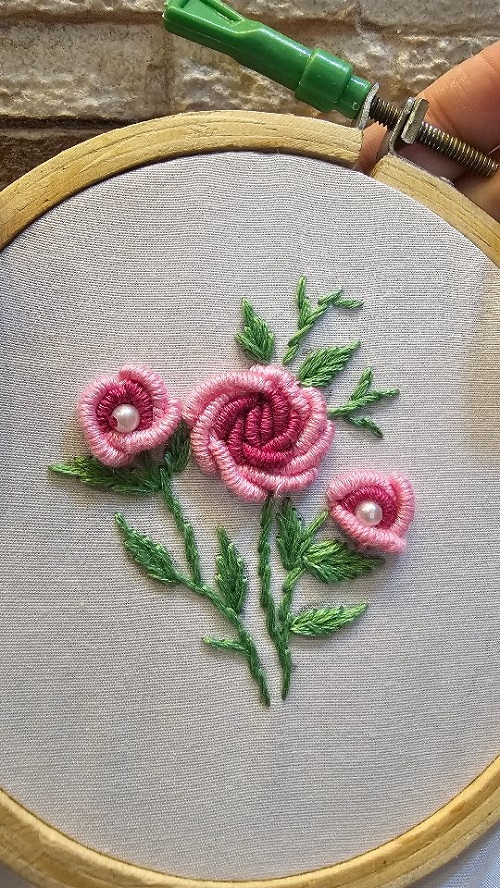
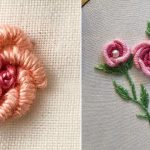
If you enjoy floral embroidery, learning how to stitch a bullion rose is a great way to add flowers to your designs. This rose uses bullion knots, which may take a little practice, but the finished flower looks lovely. Start with a small center made from French knots or satin stitches, then work bullion knots around it to form the petals.

If you are new to bullion knots, practice making them in different sizes first. You can also make curved bullion knots by wrapping the thread more times than the stitch length requires. This tutorial uses perle cotton, but you can also use regular embroidery floss, crewel yarn, or silk ribbon.

You can stitch bullion roses alongside other flowers, such as woven wheel roses and lazy daisy flowers, to create a floral design. A single rose with one or two leaves looks just as nice. Once you get comfortable with the stitch, you can use it in many embroidery projects.
What You’ll Need
- Embroidery needle, size between 1 and 5
- Small sharp scissors
- Embroidery hoop sized for practice cloth
- Six-strand embroidery floss
- Small square of cotton fabric for practicing
Bullion Knot Rose Tutorial
A bullion knot rose is made by stitching bullion knots around the center. Each row of knots gets a little larger as you move outward. Bullion knots are similar to French knots, but you wrap the thread around the needle more times. For the outer petals, you can add a few extra wraps to give them a curved shape.
Get Ready
A bullion knot rose is made by stitching bullion knots around the center. Each row of knots gets a little larger as you move outward. Bullion knots are similar to French knots, but you wrap the thread around the needle more times. For the outer petals, you can add a few extra wraps to give them a curved shape.
Work a Bullion Knot
1. Bring your needle up through the fabric at point (1), where you want the top of the bullion knot to sit.
2. Take the needle down through the fabric at point (2), which marks the bottom of the stitch. Then bring the needle tip back up at point (1). Keep the needle in the fabric.
3. Wrap the thread around the needle several times. Use enough wraps to cover the space between points (1) and (2). Keep the wraps close together, but don’t pull them too tight.

4. Hold the wraps gently with your non-dominant hand. Slowly pull the needle and thread through them. If the wraps feel too tight, twist the needle slightly to loosen them. Keep pulling until the knot begins to lie flat on the fabric.
5. Take the needle down through the fabric at point (2) to secure the knot.
6. Use your fingers to arrange the wraps and smooth the knot until it looks neat.
Tip: To make a slightly curved bullion knot, add a few extra wraps around the needle. The wrapped thread should be a little longer than the space between the two stitch points. This extra length helps the knot form a gentle curve.
Begin the Rose
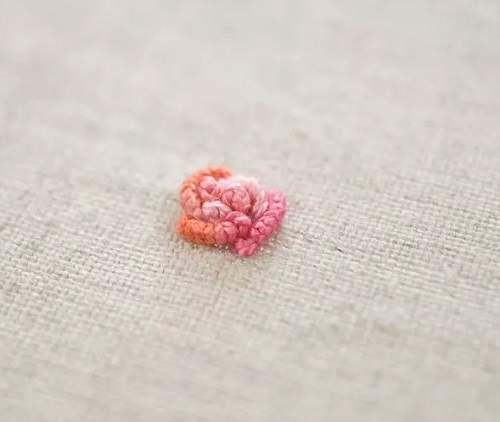
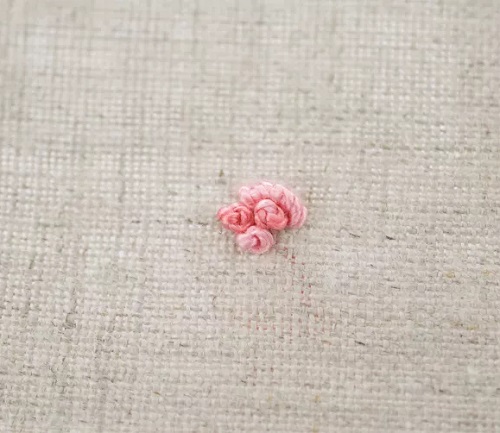
Start by stitching the center of the rose. You can make a small group of French knots, as shown here, or use a few short straight stitches placed close together to create a satin stitch center.
Next, bring your needle up near the center and make a bullion knot around part of it. This will form the first petal of your rose.
Tip: If you’re using perle cotton or a similar thread, pay attention to how the thread twists as you wrap it around the needle. If the thread starts to untwist, wrap it in the opposite direction to keep the stitches neat.
Add Petals: Curved Bullion Knots
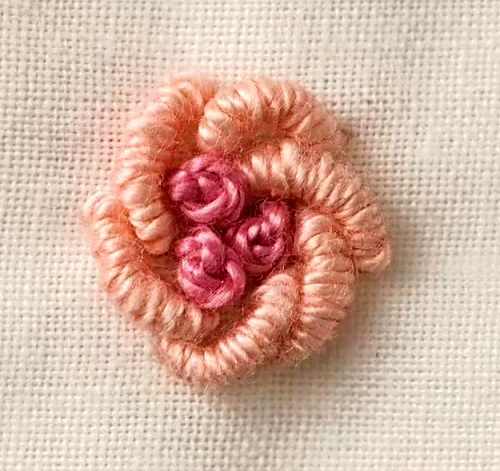
Add more bullion knots around the center to make the rose petals. Let the end of each new stitch overlap the previous one slightly instead of meeting it exactly.
As the rose gets bigger, make your stitches longer. Add more wraps around the needle to give each stitch a fuller curve. You can change the look of the rose by making the bullion knots different sizes and shapes.
Bullion knots use quite a bit of thread. If you’re using variegated thread, pay attention to the colors as you stitch each petal. If the next knot will be the same color as a nearby petal, place it somewhere else instead of stitching it right beside the same color. You can also start with a new length of thread to get a different color.
Finish the Rose
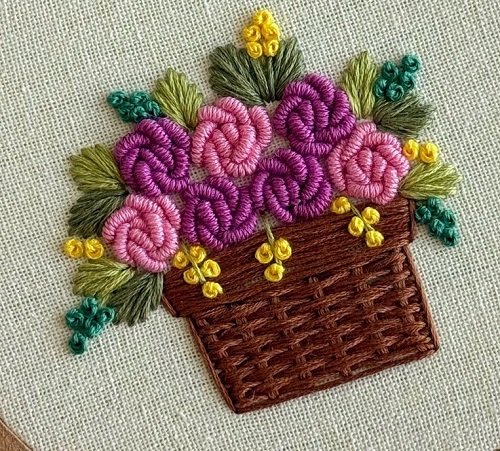
You can make your bullion rose as large as you like by adding more bullion knots around the flower. As the stitches get longer, you may need to use a longer needle, such as a milliner’s needle.
If the stitches lift too far from the fabric, you can hold them in place with small stitches, using the couching method.